Sunday, March 12, 2006

I love you in the mo-orning ...

Sunday morning is different.

Travail. Agony. Decisions. Prompted by an all-consuming imperative. Truly all-consuming.

Hunger. I’m always hungrier than usual on Sunday mornings. Damn.

So what should it be? Kochuri-torkaari and jilipi from Maharani? Hot, slightly crisp, a hint of heeng (asafoetida) in the daal stuffing of the kochuri, the accompanying torkaari just this side of fiery and speckled with cumin seeds. The jilipi convoluted, crunchy, faintly sour under the sweetness of the syrup. Sadly enough, Maharani - on the western side of Lansdowne Road between Lake Road and Rashbehari Avenue - hadn’t come up back when we rowed on Saturday mornings. We made do with Jolkhabar, at the corner of Lake Avenue and Southern Avenue, but frankly, their shingara was much better than the kochuri torkaari. And their jilipi was of uneven standard.

(OK, assume there’s a reader or two who’s not from Calcutta. Or even Bengal. Kochuri is a fried bread – stuffed with spicy ground lentils, rolled flat, then deep fried so it swells to an inflated mouth-watering shape. Torkaari is the generic term for vegetable dishes. In this case, it’s potatoes diced small, in a spicy thin curry. Jilipi ... now jilipi or jalebi is a tough one to describe. It’s sweet, it’s twisty, it’s crisp, it’s doused in syrup and you do not want to know how it’s made. Shingara is called samosa elsewhere in India, a triangular pouch of dough stuffed with savoury vegetables and deep-fried. Available at just about any sweet-shop in Bengal. My grandmother used to make the best in the world - the crispest, flakiest pastry-crust envelope, filled with succulent florets of cauliflower and spiced potatoes and crunchy with posto, poppy-seeds. All soul food, if not exactly health food.)

Or should it be the same fare from Tasty Corner? Good, but not quite so good. The torkaari is rarely up to scratch, the jilipi is more like amriti and often doused with rose syrup. I hate that. But Tasty Corner (corner of Swinhoe Street and Mandeville Gardens) scores heavily with the radhabollobi and aloo’r dom. Even better than the Dwarik’s at Gariahat, and that’s saying something.

Of course I didn’t realise the depth of my craving for kochuri-torkaari on Sundays until I pined for it in exile. After weeks of bagels and Philly cream cheese, of “sunny side up” and pumpernickel bread for breakfast, I stayed over at a friend’s place on the weekend. Up on the Jersey shore, not too far from Jackson Heights and Edison, those bastions of mixed pickle and papad. On the Sunday morning I poured forth my home-sickness over the morning cuppa and he, God bless his kind heart, drove me twenty miles to pick up … yes, you guessed it, kochuri-torkaari, even jilipi by the bucketful. Perhaps it wasn’t the best I’ve ever had, but after six weeks in that benighted country it was manna in the wilderness. Here’s to you, A*, you earned my life-long gratitude that day.

The ultimate kochuri experience remains elusive. Kalo’r dokaan in Shantiniketan, or his newly resurgent competitor, Nara’an, are just not equipped to deal with the hordes who descend upon them during Boshonto Utshob and Poush Mela. Their kochuri comes off poorly in the general melee. Of course, there it’s all about the atmosphere. At least in theory. There is a special charm to flip-flopping down those roads of red dust, a shawl thrown round the shoulders to ward off the chill of the morning, then sitting for hours on a scarred wooden bench with a leisurely breakfast and endless rounds of watery sweet tea in earthen khnuri. But it can’t make up for bad kochuri.

Kalo’r dokaan (shop) has one thing in common with the kochuri breakfast of my dreams. Chholaa’r daal. (Forget the translation, it’s a kind of lentil, OK?)

Benares. An old old house near the river, up a steep staircase, through a stone doorway that opened on to a grassy little walled courtyard with three trees. One was a neem and it rustled all day in the breeze off the river. At least in my memory. And every other morning there would be huge brown-paper packets smelling of the saal leaves inside, leaves that would be parted to bring forth fragrant golden kochuri. The chholaa’r daal would be carried separately, in a large earthen pot sealed with more saal leaves and tied at the mouth with grass twine. It tasted divine. I remember it would sometimes have minute chunks of coconut, or does my memory play tricks on me?

We’d be shooed into the house to eat, though we’d much rather have sat out in the courtyard on the masonry bench, looking out over the houses to the river and the boats and the crowds on the ghaats, while the neem whispered to its shifting shadow. There was good reason, however, for our staying in the house. Monkeys. They “fought the dogs and killed the cats”, they jabbered on the corners of the roof, they rustled in the trees at night and scared the cook into fits, they hogged the sunny corners of the courtyard on winter mornings even when my great-grandmother shook her stick at them and cursed them at the top of her lungs. And they snatched the food from the unwary hands of us young ‘uns.

One of them left me with a lasting sorrow when he swooped down from a window-ledge and neatly filched a saal leaf heaped with kochuri and chholaa’r daal. A counsellor will no doubt divine that I still seek to compensate for the lost kochuri …

****

Or should it be a “Madrasi” breakfast at Ramkrishna Lunch Home? Three cement-paved steps lead up to a narrow verandah near the corner of Lake Road and Southern Avenue. Inside, lugubrious neon lights a spotless shrine to the purest “tiffin”. Kaapi served in those double-bottomed stainless steel mugs, each on its own metal saucer for the ritual of pouring and re-pouring to cool it before the first deep susurrating sip (but the “maaan-jerr” will not call for it till after you’ve finished your “tiffin”).

A banana leaf appears on the narrow formica table, spread with magical ease by a mannikin in a dazzling white shirt and slightly less gleaming mundu. I suspect the length of the mundu is inversely proportionate to the length of service; the older staff are perilously close to being mini-skirted. Two steaming idlis follow (I remember I laughed and laughed when Span – does anybody still read Span? – described them as “steamed lentil patties”. Those were the days before “desi” became international usage). With two little steel bowls on the side, one with coconut chutney and one with sambhar, both ladled from that strange contrivance which has three bowls slung round a single rectangular handle. Then … ahh, then comes the piece de resistance, the ultimate dosai, the best I’ve ever had north of the Vindhyas. (Down south, of course, there’s always Woodlands. In Madras and in Bangalore ...) Crisp round the edges, almost fluffy in the centre, redolent with the aroma of ghee, faintly sour from the fermentation of the batter. (A little bragging: I used to make decent dosai myself, even used the professional touch – lopped off the end of a brinjal and used it to spread the batter on the tawa - but of course I never attained the papery perfection of the professionals.) I always have a sada dosa, never ever a masala one. Sully a good dosa with potatoes and even – Lor’ lumme! – beetroot? Perish the thought!

Raj (or to give it its full appellation, Hotel Homely Raj) on Manoharpukur Road also serves a mean dosa, but it can’t compare with RK Lunch Home either on price or for authentic atmosphere. I know people enthuse over Anand. Let them. RK Lunch Home for me every time.

The other Southern delicacy I lust for is appam, and there’s only one place in my experience (I’ve never been to Kerala, mind) that consistently serves perfect appams with ishtu. The Konkan Café at the Taj President in Bombay. Nowhere else is EVERY appam perfect. Nowhere in Calcutta, alas, not a single place. The Taj Gateway in Bangalore isn’t bad, but it doesn’t have the same consistency of performance. Chef Solomon at the President (may his tribe increase!) actually confided to me the secret ingredient which ensures that every single appam rise just right. While I am honour-bound not to disclose the secret, I can say this much - it’s not something you’d find in the average kitchen. Or household. Oh for a platter full of the warm south, the true, the magical appam serene!


****

There’s also the calorie bomb. The so-called English breakfast. Eggs and toast are all very well (more of that later), but for a breakfast that leaves you with barely enough strength to totter from the table, give me sausages, give me chewy ham, give me rashers of bacon that loll voluptuously on the side of the plate, give me the contrast of spiced beef and cherry tomatoes.

The Park in Delhi used to have a sinful breakfast buffet that tested even my gormandising abilities. Do they still have it? I must check it out when I next visit. In Calcutta, the best bet is Kalman’s. A narrow doorway on Free School Street, tucked away among the second-hand-music shops between Mullick Book Store and Kathleen’s. I learnt about it from a 1998 column by Nondon Bagchi in the Telegraph. They now have the column framed on the wall. They also have unique stuff, like the “Hungarian smoked sausage” which is arguably neither Hungarian nor smoked but tastes great especially when dipped in egg yolk (oh the cholesterol!). Also spiced beef and even pressed tongue. The tongue is not exactly great, but what the hell, I try it once in a while in homage to all those Enid Blyton picnics where it was a staple. Such a menu leads to a torment of choice, since a breakfast like that removes all possibility of lunch and Sunday lunch is Very Special. But this post is about breakfasts. We shall not lament the loss of lunch.

****

Breakfasts of legend and song … three years ago I spent a week in Moscow. The hotel where I put up had colourful ladies importuning the guests in the lobby. It also had the most magnificent breakfast I can imagine. I reasoned that with the mercury at 22 below zero, I needed lots of nourishment. Forsook all shame and decency. And plunged right in.

Starting with an array of breads: chocolate bread, cream rolls, fruity breads, muffins, perhaps a few pieces of fruit, all washed down with glasses of cold milk. Then on to a most incredible cheese selection - feta, Gouda, brie, Emmentaler, herb Cheddar, you name it - while the waitress brought me a plate of eggs. (From the second day onwards she regarded me with a strange mixture of awe and pity. As much as to say, this man’s powers are beyond the ordinary but I hope to God the paramedics turn up quick when he has his attack) I ate the eggs with chornyi. This is the most wonderful chewy whole-grain bread, so dark it’s almost black, soft inside a crisp crust and just faintly sour. I’ve looked for it elsewhere but never found it, it’s unique to Russia. Moscow is worth another visit just for chornyi!

Finally, breathing heavily and already loaded to the Plimsoll line, I’d navigate carefully to the end of the buffet for a couple of tinned peaches and apricots. To be eaten very slowly. While I sipped my way through two glasses of champagne. (Champagne breakfasts. TWO glasses of champagne. Every day for a week...) Dear reader, do not think ill of my gluttony. My suits did not stretch an inch. The warmest day was still six degrees below freezing and I had to walk a few miles every day. But oh, the sheer debauched sybaritic pleasure of those breakfasts.

One important point in closing. Before the adipose reached dangerous levels, my standard breakfast was toast and eggs. Toast just brown enough and dripping with butter, eggs (always in the plural) winking from the plate or losing themselves in the fluff of an omelette. My heart and taste-buds, however, always stayed with the omelettes. I have described them elsewhere on my other blog, I shall not venture down that path again. The point I want to make is this. Mr. Russi Mody, whom I hold in high regard, has claimed in print that he makes the world’s best omelettes. This is, unfortunately, a lie. It cannot be true. I make the best omelettes in the world. This is not idle bragging, merely an objective statement of fact.

And next Sunday I shall make another one.

Sceptics are NOT invited.

Finis.

**** ****

Thursday, March 09, 2006

A search for roots

Random update. Siddharth Suryanarayan is hot. Half the people who have dropped by this blog recently have been looking for him, including one plaintive search string – “Is Siddharth Suryanarayan married?”. He is. One’s heart bleeds for the disappointed singlettes.

Further disappointment – those who were looking for “jap sex” or “sex jap”. Sorry, rrong rumber. Ditto for those who sought “last gap erotica” (ainh?!) or “bangle panu golpo” (aha! Yellow cellophane covers!) or “Indian panu”.

But hey! “Bonguly” is right up there. Welcome home, the diaspora!


**** ****

Monday, March 06, 2006

Poem on the Underground wall


Seven o’clock on a darkling evening. I am a neon hermit in a deserted office. Windows rattle shut, doors close around me, footsteps fade down the stairs. Thunder rumbles far away, a tip of the hat to cliché.

Last train is nearly due / The Underground is closing soon / In the dark deserted station / restless in anticipation / a man waits in the shadows …


There was a dim lamp above a mahogany wardrobe. There was a dressing-table with a three-wing mirror that held more than reflections. Through the two doors of the bathroom lay the drawing-room with its frayed sofa and the cabinet with the television and the music system.

The music system was (then) state-of-the-art, though it would take another 15 years for the phrase to emerge. Sonodyne, with a gleaming brushed-silver amp-cum-deck, toggle switches like a ’50s aeroplane and two speakers in black wood cabinets each large enough to hold a baby. Thin black wires looped across the green wall behind the cabinet, soaring up to the corners of the ceiling where the speakers brooded.

Late at night I would sneak across from my room to the drawing room to listen to music. I was 15 years old and I had just discovered rock. In fact, I had just discovered music, from Kishore Kumar to Don McLean (and kids today know that American Pie is a Madonna number). Holiday afternoons were spent in K*’s room overlooking the Lakes, sorting through piles of carefully recorded cassettes (Sony D-90s, white with a red and black spine, are they still on the market?), checking our knowledge of The Boss’ songs.

****

I loved those afternoons. Somewhere I have a picture of K**, small dapper person in kurta-pyjama, strumming a guitar in his green-walled room with pictures of The Boss stuck on the wall behind him. I wonder what he did with those pictures when he moved to Bombay? Poor Bangali boy, he got bowled over by a … Person. Married her, too. As a result, we hardly meet even when I go to Bombay. I miss the blighter.

My wife misses him just as much. In one album we have pictures of him taken one December when he came with us on a weekend launch cruise into the Sundarbans. We didn’t get to see a thing except the track of a python in the sand, but the trip is a pleasantly hazy memory of appetites sated on good food, of in-jokes and K**’s snorting laugh, of anchoring mid-stream under a pale moon and singing on the deck “to scare the tigers away” (it must have worked).

Another picture, this one on the terrace of his apartment building the first time we ever won an open quiz, the Argus Losers’ Plate ... Scrawny smug twerps with the wooden shield on a concrete thingummy between us. Under-exposed, out of focus, even after determined Photo Shopping. But you can make out how proud we both felt. And I can remember how non-touchy-feely, intensely homophobic, faintly-repressed K* hugged me spontaneously when we won.

We met up two years ago when I was in Bombay for a bit. There was another guy there; I think that actually made us more comfortable together. K** of the carefully arranged wavy coiffe had become amazingly corporate, all gleaming white shirt and St. Michael’s tie. But after a while his snorting laugh came back. We were still friends.

We mail once in a while. Sometimes I come across something that I just have to share with him, we talk on the phone. Today he called to say he’s moving to the Middle East. For at least a couple of years.

I miss the blighter, I really do. Do you have a friend you miss like that?

I so hate that ... Person … for taking him away from us.

I suspect he feels the same.

**** ****


Sunday, March 05, 2006

From the inside out

Back in 1990, forty of us volunteered for a “study tour” of the insurgency in Kashmir. Our Course Director was aghast, he thought the Grand Old Man (the Director of our Academy, two parts genius and one part fraud but 100% effective) had lost his marbles. The insurgency had just flared up big-time and the possibility of an Officer Trainee getting shot up in the Valley was enough for R* T* to lose sleep.

But we went. I was there for two weeks. There are a lot of stories in those 14 days. The stomach-clenching silence in the alleys of Batmaloo after Ishfaq Wani was shot down. A flurry of movement seen from the corner of my eye and a convoy stopped yards from a hole in the road – with wires leading from it to the hilltop. A whisper in my ear while we were being served dinner, a warning that the whole town knew where we were at any given point of time. Above all, the bad bad feeling of being unwanted, outsiders, “Indians”, foreigners in what we had thought was our own country. Some day I must write down those stories and hope that the Thirty Year Rule doesn’t apply to personal memoirs.

Meanwhile, my friend just mailed me this piece from yesterday’s New York Times. (Thanks, Sanjay.) I can’t locate the link, hence the reproduction here. Hope I’m not violating any copyright.

Lessons from another insurgency – Anit Mukherjee, Washington

DURING his trip to South Asia, President Bush has done his best to whistle past the diplomatic graveyard of Kashmir, issuing only bland encouragements to the leaders of India and Pakistan to resolve the status of the disputed territory. That's a shame, because instead of ignoring Kashmir, Mr. Bush and his administration should be studying it as a case study in dealing with an insurgency.

"I joined the insurgents only because of you," the young Kashmiri man told me, sobbing, "because of the way you humiliated me, they way you tormented me. To regain my honor, I picked up the gun." It was one of my more shocking encounters during my two and a half years of counterinsurgency duties as an Indian Army officer in Kashmir. Shocking, because it was the antithesis of everything I had worked toward. The self-awareness that inevitably dawns on all soldiers in a combat zone came upon me: I was not a part of the solution; I was the problem, or at least part of the problem.

I had regularly summoned that young man to my post to ask him about militants in my area of responsibility. I singled him out because other villagers had told me that he was in the know. As I subsequently discovered, this information was false, fed to me by the villagers because this boy, from the wrong side of the tracks, had fallen in love with a rich man's daughter. Later, upon his word that he would have nothing more to do with the insurgents, I let him go, promising, in turn, to leave him alone. I never saw that young man again and hope that he is safe, wherever he may be.

During the first year of my counterinsurgency duties, I believe I created more insurgents than I, for want of a better word, eliminated. This was not only because of inexperience, but also because I lacked fundamental knowledge of the terrain, the people, the culture. I also didn't know how to sift through local intelligence effectively.

As a result, I mostly drew on tips and informants who, with hindsight, were mostly unreliable. The motives for giving me this information were usually property and land disputes, family feuds, tribal and ethnic conflicts and other causes unrelated to the insurgency. Thus, a combination of my own naïvete and enthusiasm, not to mention pressure from senior commanders to deliver results, resulted in actions that alienated the locals and, inadvertently, helped the insurgency.

It was only after a year of combat operations that I was able to build up my own intelligence network and gained the experience to be effective. Although conventional wisdom says that the tours of duty should be short, in my experience militaries fighting insurgencies should instead keep junior officers in the field for as long as they can. Successful counterinsurgency campaigns have usually been small-team operations led by junior officers with intimate knowledge of their areas of responsibility.

After the first year of conducting operations with questionable results, my unit made a significant shift toward people-friendly operations. That meant taking off shoes before searching mosques, deciding not to search old men, women and children and even letting insurgents escape rather than risking a firefight in a built-up area.

Over time, our hard work paid off. Tips became more frequent and reliable. As we gained the trust of the locals, we succeeded in preventing recruitment while eliminating insurgents.

As the insurgents in Kashmir lacked the ability to mount conventional attacks, their weapon of choice was the improvised explosive device. Eventually, we largely neutralized this threat by constantly changing our tactics. By being unpredictable and undertaking intensive offensive operations, admittedly a function of abundant manpower, we seized the initiative and became the hunter rather than the hunted.

One of the few, and rarely noticed, successes of Indian security agencies has been their ability to subvert an insurgency. For example, in Kashmir, Indian intelligence services were able to buy out an entire strand of insurgents in the mid-1990's and create local counterinsurgents called Ikhwanis. For a time, they were extremely effective, and were able to wipe out the local insurgency before the foreign-born jihadis poured into the valley. By the time we deployed in the valley in 1999, the Ikhwanis themselves had become corrupted and were being phased out. But that experience taught us how critical it was to co-opt the locals into our counterinsurgency strategy.

Undoubtedly, the Indian Army has learned a lot after 16 years in Kashmir, but its experience raises the question — can a military learn without bleeding? The sad answer is no.

Almost four years have passed since I left the Kashmir Valley. Although the conflict gets less public attention, civilians, soldiers and militants still die every day. Despite the seemingly endless daily toll, a few months ago the commander of India's Northern Army at the time, Lt. Gen. Hari Prasad, had the confidence to declare that "normalcy is round the corner."

True, the level of violence in Kashmir has decreased and this augurs well for peace in the valley. But the Indian Army has not, and can never, quash the insurgency. On the contrary, one of the first lessons taught to all soldiers deploying in Kashmir is that an insurgency can never be militarily defeated. It can only be managed until a political solution is found — a lesson that the Bush administration would do well to remember.

Anit Mukherjee, a doctoral candidate at the School of Advanced International Studies at Johns Hopkins, served in the Indian Army for nine years.

PostScript: Link found. Amit Uncut has already blogged about this. Great minds etc.

(Thank you, KP, Griff)

**** ****

Tuesday, February 28, 2006

Rebirth?


Chandresh Narayanan in (where else but ...) the Times of India informs us that Andrew Flintoff may miss the Third Test. He (Flintoff, not Narayanan) will fly home for “the birth of his new-born child”. Born-again bairn, eh?

Belief in rebirth is not new to the ToI. As Kaushik pointed out, six months ago they wrote of a Tollywood actress who was “recovering from a fatal accident”. Hope springs eternal etc.

**** ****

Sunday, February 26, 2006

So the owd Gaffer, he sits heself down with hi' pint i' the corner, and Lord! does he go on ...


I now have this chip on my shoulder. A tracking chip, I suspect. One of those things DHL and FedEx use, and it’s more IN my shoulder than ON it. A tag, a meme even. This person fired it in to begin with, and now she’s waggled it about a bit. That plays the very devil with my old bones, you know how it is, rheumatism and the gout and all that, so here goes in enlightened self-interest….

Just a minute... Hold it right there, me hearties. You want to hear me ramble on about books? Luvverly. Could go on forever. Or almost. But it’s not fair to tie me down to categories and numbers. Deal? (Statutory warning - I have read nothing by Banville, Barnes, Ishiguro, Morrison, Murakami or Ondaatje. I detest Arundhati Roy. I've had it up to here with magic realism. I love Amitav Ghosh but have not yet read The Hungry Tide. I haven't even read Two Lives for fear it will not live up to the breathless romanticism of An Equal Music. Salman Rushdie will not be mentioned again here. Read on, then, only if you can suppress the shudder of disgust at this semi-literate posturing.)
Here goes, again. (But you’ll be sorry!)

Total number of books owned – Tough call. Does one include the early Ladybird books and the Noddy series, a couple of hundred Armada publications (Auntie Enid had two full shelves to herself!), the Three Investigators, William, Amar Chitra Katha and Classics Illustrated? Does one count only books one values or the motley James Hadley Chases and the odd tattered copy picked up from a sidewalk vendor for five rupees (e.g. The Discourses of Epictetus, I actually read it through one weekend, now I have no idea why)? Can one leave out Aabol Taabol and Thakurma’r Jhuli just because they’re not in English? What about the trunks full inherited from my grandfathers? Or the stuff that mysteriously accumulates in my parents’ place, so familiar and yet rather strange, like women who wave at me in multiplex foyers, whom I KNOW I know but I don’t know who the hell they are …

Sneck up, you havering awd coot, gi’e the childer a number. Well … 1500? 2000? Spread over three distinct locations, including all the favourites I had as a child, NOT including the bad debts that I shall never retrieve but including all books that have remained with me for 2 years or more (regardless of their original owners. Fair trade, surely) - a couple of thousand, then. Give or take a hundred.

Last book I bought – Lynne Truss’ Eats Shoots and Leaves. Needs no introduction. Also (in Bangla) the complete short stories of Satyajit Ray. A large number of them are now available in a very good English translation by Gopa Majumdar, but I’m afraid the essential appeal lies in their very Bangaliyana and that doesn’t translate perfectly. Der Boss is not like Amit Chaudhuri in that he does not recreate and present a Bangali ethos, he is Bangali.

(Digression – life-changing moment. A few weeks after 9/11, fretting all night by a chilly window in New Jersey over whether I should stick with a PhD ‘program’ stateside or cut my losses and return to my beloved Calcutta, I plugged into the VCR a recording of some Satyajit Ray interviews. And the Man was asked whether he regretted not having moved to Bombay or even to Hollywood in pursuit of his cinema. In that inimitable rumbling bass, his speech a mellifluous synthesis of Oxford studies and Calcutta baithakkhanas, he said ‘Wellll … my roots are in Calcutta. I grew up here, I have worked here all my life, my inspiration is here. I do not (did he ever say ‘don’t’? I cannot recall an instance) think my creativity would have survived my moving to another city”. Eureka! My decision was made for me!)

(Digression #2 - I loved A Strange and Sublime Address. It’s easily one of the most evocative accounts of childhood that I have encountered, probably because it mirrors my own experience so closely. I learnt from Amit Chaudhuri how observation of the seemingly trivial details of the everyday can fill in the background of a word-picture. And I hated him for having written it, and written it so much better than I ever could. My big mouth … when I met him for the first time, I told him “I resent your having written the book I always wanted to write”. Ever the perfect gentleman, his response - after the first incredulous stare - was a polite smile instead of “Yeah right, you and Proust both!”)

Last book I read – I have a very low attention-span. I usually read about three books simultaneously, dipping into them in greedy little interludes rather like a sticky-faced Bunter in a Fifth Form study. I have to choose one from the pile.

The last book that I read with undivided attention was Elizabeth Kostova’s The Historian. It’s a … well, call it a research mystery. (Not, of course, as successful as Dan Brown’s opus, because it has certain shortcomings. Ms. Kostova wastes time on characterisation. She describes people, places, events. She drifts into history. She creates atmosphere. She even goes so far as to write good English. Worst of all, she actually writes about research! So obviously she can’t begin to approximate the phenomenal success of our Master of Moronicity. She can’t write a “threatening silhouette with glowing eyes”. )

The Historian is not just about things that go bump in the night. It’s a travelogue, a glimpse of history, a very different kind of detective mystery and a love story. Several love stories, in fact. The love of a student for his teacher, love between man and woman, boy and girl; the love a daughter bears her father and above all, the obvious love of a bibliophile for books and knowledge. I felt let down by the last 30 pages or so. It appeared she hadn’t plotted the ‘climax’ carefully enough. But in this book, the journey is far more important than the destination.

Currently reading – well now, let me see. There’s The Manticore’s Secret. (All right, I cheated, I finished that after I started writing this post. But surely we senior citizens can take some liberties!) I didn’t enjoy it as much as I did the first book (The Simoqin Prophecies, go read it, preferrably after buying it rather than borrowing it, thus increasing my chances of sunny company when I next visit Delhi).

For one thing, if you must write an epic, write it in 900 pages and not 470. You just need more time to develop each strand, otherwise it reads like L. Mukherjee’s history books. Furthermore, I sadly fear our favourite Duck has let himself be subverted by Serious Thoughts. Always a mistake; in this case, it has led to too much talky-talk. Endless pages where Gods, politicians, magical beings expound their philosophies and agonise over their possible courses of action. Where’s the meat, bub?!

Perhaps I’m unfair in expecting a lighter touch, in demanding soufflé instead of dark truffle. There are some delicious bits, like a phalanx of Minotaurs called the Vindiciti Hoplites. The angriest of them is Jekl Amota. And of course, the umbawa or chameleon whose mantra is Eitiktikitamohapichonpaka. (You won’t get the point if you don’t know Bangla).

What else? A collection of Rudyard Kipling’s Humorous Tales. The man was so prolific, he was essentially a pen-and-ink blogger a hundred years ahead of his time. I think his stories of the “Soldiers Three” are among his best characterisation, the dialogue (even with all the faux accents) always a delight. (One could argue that The Man who would be King grew out of these stories.) Some of the other stories here are no better than average, but they show the craftsman at his work. More of which later.

Peter Hopkirk’s The Great Game, an account of the (largely) silent struggle between Britain and Russia to gain control over Central Asia, from the 18th to the early 20th century. Hopkirk is a decent writer who appreciates and tries to emulate great writing although he doesn’t quite have the touch of greatness himself. His research and the scale of his subject-matter, however, make this a very rewarding read. (His first line grabs the attention – “It was said one could smell them even before one heard the sound of their horses’ hooves”) Think of it – the sweep of rugged terrain from the Caspian Sea, across the Persian Desert, over the western outcrops of the world’s highest mountains, through the tortuous passes of the North-West Frontier and on to the Roof of the World. Soldiers, spies, adventurers, despots, disguises. Intrigue, violence, bravery. Infallible recipe, best illustrated by the story of Col. F.M. Bailey, British officer and adventurer who traveled through Central Asia in disguise and in peril of his life. Until one day in Tashkent the Cheka, the Tsarist secret police, tried to recruit him for a specific mission - to find and assassinate a notorious British agent named Bailey! (Bailey’s own account, A Mission to Tashkent, also suffers from stolid prose and an irritating attention to minor detail, but again, the story is too wonderful to be buried under poor writing.)

Paperweight, a collection of articles that Stephen Fry wrote for The Listener and The Daily Telegraph. Often funny, usually witty, keenly observant, casually erudite and always well-crafted. Fry is one of those writers who are good even when they are bad. I must confess that I don’t always enjoy his novels with their darkling farce and their accounts of agonized homosexuality, but this collection is just right for my ‘dip-dip-dip’ style of reading.

Foucault’s Pendulum (by Umberto Eco, and if you have to ask, you can come and share a smoke with me while we both try to work it out). Never mustered the courage earlier, have taken the plunge this time. No more at this point!

Finally, a book that I have had by my side for some months now. My friend and guide in Delhi, quite an expert on the history of science, said he was disappointed in this book. I, on the other hand, love it and come back to it every other day. Bill Bryson’s A Short History of Nearly Everything. The joy of reading about science in a lucid account, and a fleeting feeling of virtue at the betterment of self!

Books that have meant a lot to me – Five? Just five in nearly 40 years? Pshaw! Fiddlesticks! I intend to step high, wide and plentiful, and if you don’t like it you can go read a biography of Narendra Modi! The tough part is to keep it down to a hundred. On the other hand, I just advised somebody (only after the said somebody sought my advice, I hasten to add) to keep it short. Considering this post is already 1500 words and counting, perhaps I should keep it down to 5. But how?

The complete works of P.G. Wodehouse. Cheating? All right, Wodehouse on Wodehouse. Still cheating, because this is three books (Bring on the Girls, Performing Flea and Over Seventy) in one, but this is my list! Apart from the sheer joy of seeing the Master at close quarters, this volume repeatedly drives home the overweaning importance of hard work and discipline. I have earlier listed the reasons why I consider Wodehouse "the finest writer of English in the 20th century”. His virtuosity was that of an honest and sincere craftsman, the kind who cleaned his typewriter regularly so that he wouldn’t lose a good idea to a stuck key. Not everybody can be a Douglas Adams, who loved “the whooshing noise of deadlines as they flashed by”. PGW wrote every day - every day of his life for 70 years, including three and a half years in prison camps. I’ll try for 1000 words a day, Sir P. And pay homage in my own way to PGW and the Beetle. As the Bouncer wrote recently, the only way one can learn how to write well is to read and write and read and write. And then read and write some more.

The Once and Future King, T.H. White. History, fantasy, allegory – difficult to categorise this magical re-telling of the Arturian legend. I choose this over The Hobbit (which again is far far superior to TLOTR, an over-blown and self-important heavyweight that occasionally descends to the levels of the later Harry Potters) because it has more moods, more introspection, more drama, much more laughter (and more sex!) without becoming maudlin or preachy. The first volume, The Sword in the Stone, provided the basis for the Disney animated film; the fourth, The Candle in the Wind, is closer to Excalibur. How’s that for wide-spectrum?

Zen and the Art of Motorcycle Maintenance, Robert Maynard Pirsig. Because it explained that philosophy is no more than thinking things through. Because it wove personal trauma and general principles into a story. Because it made me address my own mental block about technology. Because it gave me a glimpse of how terrible it would be if I could no longer think. Because it made me think.

English, August by Upamanyu Chatterjee. The parallels with my own experience kept me sane through one rather difficult year of my life. I even found a toad in my bathroom in the Circuit House. (My copy, bought in 1991, has a line from Paul Simon’s Kathy’s Song on the fly-leaf: “There, but for the grace of you, go I”. We too were young once.) Read with John Beames’ Memoirs of a Bengal Civilian – the more things change, the more they stay the same. And Philip Mason’s (or Woodruff’s) two volumes on The Men who Ruled India.


Cheat update - how could I forget H.E. Bates' "The Darling Buds of May"? And John Hadfield's "Love on a Branch Line", which is more of a 'novel' but far less of a romp. Two stories with similar themes, the first published in 1958 and Hadfield's in 1959. Coincidence or .. ? Both adapted for television, and I assure you that I loved the Pop Larkin series long before a certain Welsh lady appeared in The Darling Buds on TV (but oh, those brandy eyes, that sinfully amused mouth!). I mean, look at what these books pack for me. Civil servants giving in to hedonism (also civil servants as symbols of strait-jacketed, deprived, mentally fettered life. But I shall let that pass). Lots of food. Innocent, fun-loving sex. The English countryside. Nightingales and other music. How could I not stay in love with them? (Self-consciously learned aside - the 'May' here is not the month but the flower of the hawthorn. Has found favourable mention in the works of Shakespeare, W - Rough winds do shake the darling buds of may - and Wodehouse, P.G., secondary source - Of all the mad new year this is the maddest merriest day / For I am to be Queen of the May, mother, I am to be Queen of the May)

A slew of travel writing keeps me dreaming, from Pico Iyer’s Falling off the Map through Paul Theroux – brilliant in Riding the Iron Rooster, petulant and tedious in The Pillars of Hercules – to my much-favoured Bill Bryson, the master of the micro-view and the puckish aside. Eric Newby is one writer who travels better than he writes, though A Short Walk in the Hindu Kush is an undoubted classic. His anthology, A Book of Travellers’ Tales, should be prescribed reading; if this does not inspire wanderlust, nothing will. For myself, even a Frommer’s Guide can set me off.

And of course, all the men (and the few women) who make me laugh. The first four volumes of Spike Milligan’s war memoirs, and Puckoon. Mr. Hatterr. The Trilogy in Five Parts. Ascerbic verse from Dorothy Parker. Long ago, Betty MacDonald and Onions in the Stew. Tom Sharpe. Over the last two years, Terry Pratchett. (In all fairness, I should also mention Charles Devereaux and Venus in India, my first exposure to erotica.)

Enough! Or wait … poetry! A forty-year* old edition, the white binding now grey with fingering, the edges frayed. The Guvnor’s Collected Poems. And the Norton Anthology of English Literature, circa 1982. Poetry of the Thirties. I read anthologies rather than single volumes. Enough now!

Cheating again with a wrap-up – Books I want to buy? The Greater Oxford English Dictionary. The complete works of Terry Pratchett. The Argumentative Indian . Agastya Sen's return in The Mammaries of the Welfare State. (These are also the only books that come to mind immediately, in the category of books that have caught my fancy but which I haven’t read) Anthologies of detective fiction, travel writing, humour. A few dozen annuals from Wisden and Punch. All of Bill Bryson, epecially the one I haven't read, The Mother Tongue. All the Pop Larkin books by H.E. Bates. The updated Oford Book of Humorous Verse. Anything, really. Oh yes - I must shamefacedly confess that I've read very little of Neruda or Rilke. It's time I plugged that gap in my education.

Books I’ve owned but never read? Can’t think of any, unless one counts obscure treatises on sociology and criminology that appeared in our box-room some years ago. Whom do I pass this to? Really, I would not presume. But if any reader thinks this is a good idea, I warn you, it's a Sisyphean task. (This is at least the fourth time I've come back to this post to amend or add ..)

All talked out. Sorry, this has gone on far too long. But “if you prick us, do we not bleed?” If you will goad me into a book-ramble, can you blame me for losing myself on the way? I've tried to make amends by putting in as many links as possible. Those, at least, should go some way to keep the reader from rating this an utter waste of time. Happy clicking!

**** ****

* - thanks for the correction, Falstaff


Thursday, February 23, 2006

Blots on the landscape?

You don’t notice them until they’re gone.

Them? US.

Who’s ‘us’? We. The un-battered ones. The insensitive ones. The never-TALK-to-me-anymore ones. Sounds familiar?

Husbands.

I have this pet theory. (Yes, how very surprising, a real THEORY? Well, not quite a theory, more of an analogy. Now listen up)

****

Across the main road from where I grew up (down a narrow brick-walled lane that opened into a sudden garden with rose-bushes and bougainvillea, in a little square house with a wrought-iron-railinged verandah - three steps led up to it - a house with polished red cement floors and thick cool walls that smelt of damp, and two glass-fronted cupboards full of books, I remember my favourite was one about Davy Crockett and I read it every time I visited) there lived a cousin of my grandfather’s. She doted on me. (I was very dote-able in those days, all chubby cheeks and big grin.) She also doted on her cats. I hated the creatures, right from the time I was playing hide-and-seek behind her wicker-backed sofa and landed splat in a puddle of cat poop. My great-aunt was a trifle apologetic (just a trifle, mind you) but was really more concerned about the possibility of Mr. Poop-wherever having an upset stomach.

Yes, well, whatever.

Given that there were about 3 million and 24 thousand cats all over that house, I had ample opportunity to observe them. Only for brief periods, of course, I had to step outside every few seconds. To breathe. Have you ever been in an old house with a surging sea of cats? (In hindsight, there may actually have been only 4 cats, but I was 5 years old and couldn’t count too well).

So I observed these cats. They owned the damn place, my great-aunt and her family lived there on sufferance. And of course, they also had absolute rights over all chattels and appurtenances. I swear I’ve seen my great-uncle sense a dowager-like glare right through 12 pages of newspaper, look over his half-moon glasses to find Cat # 2,345,673 staring at him in icy disapproval, sigh resignedly and heave himself to his feet (newspaper and all) just so that damned cat could curl up in his favourite chair.

And a nice chair it was, too. Old “Burma teak”, wide enough for Adnan Sami, big carved lion’s-paw feet and a lotus on the end of each arm. The lotuses were badly carved; for many years I thought each one looked like a cow’s anus. (Well, seriously, how was I to know? I grew up with a khataal – tabela, urban dairy, call it what you will - taking up half our yard and thanks to the neighbourhood ladies turning up to collect loads of a certain bovine by-product, I knew what a cow’s rear end looked like.) Anyway, it was this nice chair that I would have loved to loll in if it hadn’t been full of cat hairs.

And this cat, this particular smoky grey cat with white socks, treated it like dirt. She’d claw on the legs, she’d rip up the cushions, she’d pee on the seat, on that lovely wide deep soft-cushioned seat that was large enough to accommodate two small children playing at airplanes. She’d rub herself against the wicker back and then jump back and look at it as if it was leprous. Then she’d sniff disdainfully and stalk off, her entire attitude saying “I don’t know WHY I waste my time on trying to improve that thing, it’s not as if my efforts are appreciated anyway”. Weirdly enough, for all that she pretended to look down upon that chair, she didn’t let any of the other cats lounge in it. When a cat with definite opinions does not like what you or another cat is doing, you know. There is no scope for misinterpretation, not unless you have an economy pack of iodine at hand.

Then one week the chair was packed off to the little garage next door to get the wicker back re-done and the wood-work polished. And you should have seen how that cat moped. She went sidling round the house looking for that chair. She sat in the empty space where it usually stood and she yowled for it. She clawed at anybody who tried to walk into that space. She was totally blooming lost without that chair. I couldn’t for the life of me make out why she made such a fuss.

Now, with years of experience to help me work it out, I know what the problem was. You’ve figured it out too, haven’t you?

That cat thought she was married to that chair.


**** ****

Wednesday, February 22, 2006

Damned dotage


A request, for those who have a penchant for poetry and generosity towards geriatrics. Somewhere in literary limbo there is a poem called "Ice". A somewhat Stevensonian rumination, the day-dream of a chair-bound drudge on a hot day, inspired by the calls of a man piloting a cart-load of ice through a busy street. I remember the drift of the poem (how appropriate for the lines about penguins on ice-floes) and one line ... "the carter cracks his sudden whip" (which, alas, rudely rouses the protagonist from his reverie). Another line floats on the edge of my memory like a half-recognised face in the shadows .. "Sleep drifting deep .. deep drifting sleep"

Is there any kind soul out there who can put a name to the poet and mayhap a link wherein I can find the poem? (Bartleby has failed me, and Falstaff's Minstrels don't seem to have a line search option.) There is little I can offer in return except the consciousness of compassion. Or perhaps an introduction to the delights of Tom Lehrer.

The poem came to mind because of a tap on the shoulder from 30in2005, a book meme that has effectively sabotaged my To-Do list as I (far too frequently) lean back in my chair (taking care not to tip over entirely, a hazard of these damn swivel chairs that do little for the gravitas of the gorment) and light up, dreaming awhile about bursting bookshelves and days sans deadlines. I shall deal with it anon ...

N.B. My apologies for the awful alliteration. Like Topsy, it 'just growed'.

**** ****

Monday, February 20, 2006

Krrr-Eagar-rrr! J.A.P. bundolo!


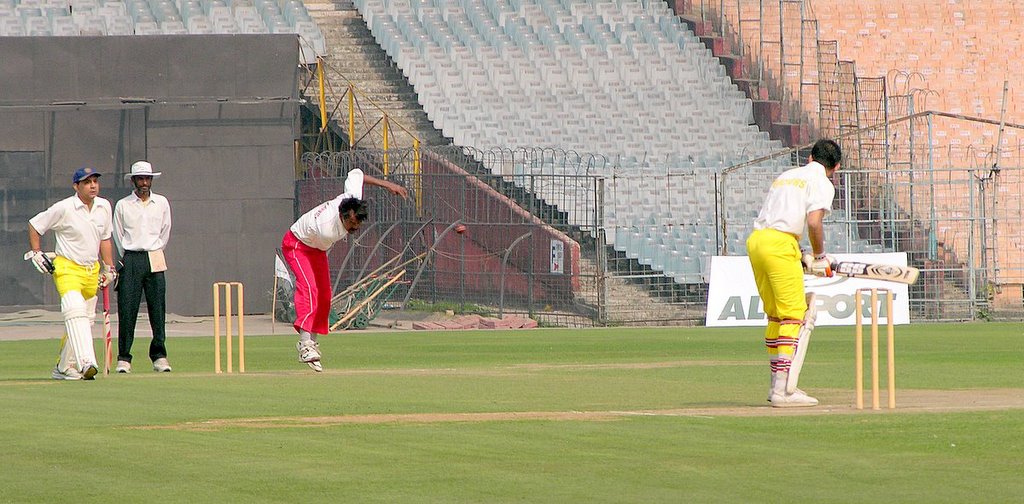
Following on a conversation with He Who is Not Flippant, wherein I was Urged to Reveal All, it occurred to me that I may be a Poor Libertarian and a Lousy Blogger, but by God I HAVE taken some cricket photographs. So you can keep the kebabs and the qawwals, I shall now post some cricket pics where you can also See the Ball.
Like so ...


Pliss to note ball in middle of trajectory. Try it some time. Not that easy without an SLR and a humongous zoom. I had to do a dozen trial shots before I got the timing right. Next time, I'll do one of those triple shutter-release settings. But that would be a little like cheating, innit?


Head over the ball, front elbow high, balance right. Reminiscent of a man I grew up watching. Except that he's not side-on, he's squared up a little too much.


Last year I batted at the Gardens. Even scored a few runs though I was sent in with less than two overs to go, but n
obody bothered to take a photograph, not even when I (almost) hit a boundary. Grrrr.

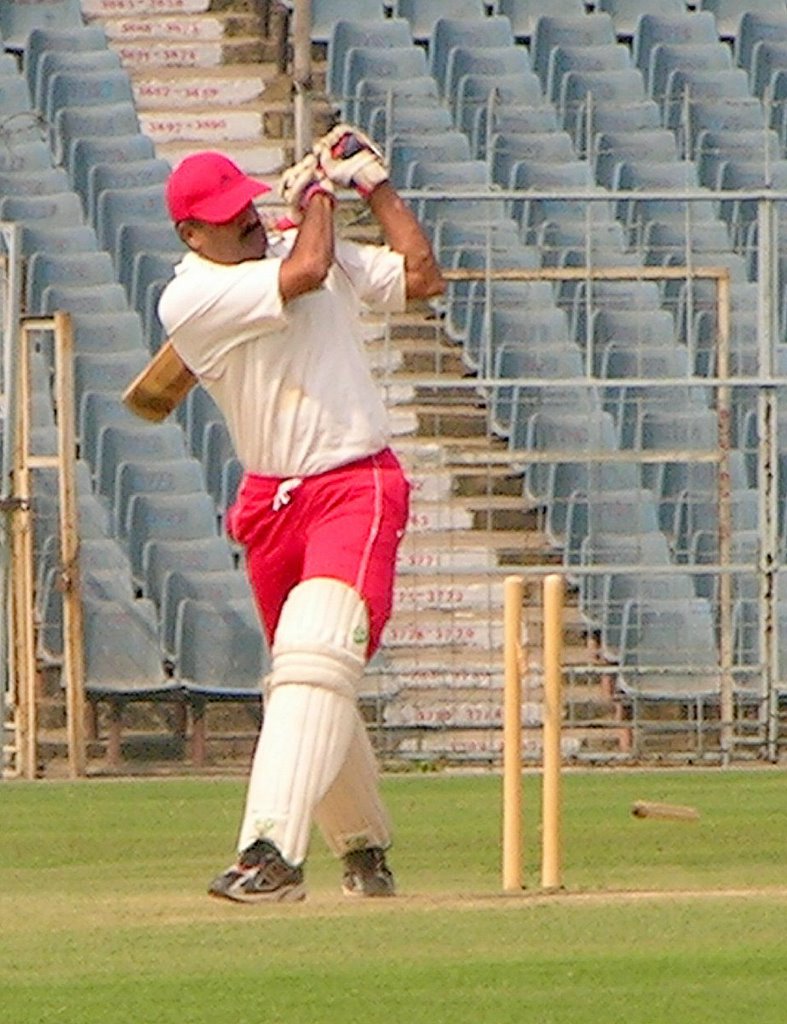
Stump flying. I missed the bails.


Don't think timing can get much better than this.
Patrick Eagar, I'm coming for you!

**** ****


Friday, February 17, 2006

2235?

If I read one more review of Rang de Basanti¸ I shall scream. Which, of course, is the cue to dole out my own Rupeej Eight-tee Shebhen hwaarth on the subject. As my grandfather used to say after watching some film on television (this, girls and boys, was back in ’lebenteen-’lebenty, when not only did we have only ONE channel [OK, two, even], teleebhishaan was only in black and white. No, not because we hadn’t got a colour TV, my grandfather was big on modern gadgets, I remember he got us a Sonodyne music system with super 9-ply boxes and a separate amp back when stereo sound was a luxury, but because DD only telecast in black & white … now where was I?) .. well yes, as my grandfather used to pronounce gravely, “Good book”.

(Which again requires an explanation of the cultural context. Back in the days when my grandfather started on the bioscope, a film had to have (gasp!) a story. Forget about films riding on “bra-panty” ensembles [Supriya Debi was almost branded a loose woman because she wore “slibhless blaauj”, the Dark Ages precursor to halter-tops], forget about “slick” and “technique”, films were based on BOOKS. Real, printed, honest-to-goodness books with stories in them. Usually by acclaimed authors [the majority of whom were Bangali, from Sharat Chandra to Premendra Mitra]. As a result, films were also referred to as “boi” or books. Haven’t heard this usage for some decades now, wish I had, it brings back so many memories)

So the story on Rang de Basanti is that it has a story. A slightly far-fetched story especially in the latter half, great gaps in credibility, but nevertheless an entertaining story. All you self-appointed guardians of the public good who pontificated on the deleterious influence of such popular media, take a break. It’s a film. It’s not a manifesto. It’s not an instruction manual. Or a Do-It-Yourself guide. These guys made the film so people would PAY to watch it, in the hopes that these paying people would enjoy the film and then go tell other people to watch it (and pay some more) because it’s good fun.

And oh yes, because it has Aamir Khan. I mean, an Outlook article on the film? Get real, Mr. Vinod Mehta. I would humbly submit that you (or Namrata Joshi, for that matter) don’t give a damn (or a ‘big rat’s ass’) about the film in itself, you ran the article (with a mention of the 2234 blogs that have posted about it) because right now the film is news, it’s what your readership WANT to read about. It’s news because it IS entertaining, it IS a hit. And deservedly so.

Some things about the film are irritating. The technique of jump-cuts with a blurred background is done so often, my eyes turned to jelly. The entire friends-having-a-great-time-together angle went on a bit too long. Siddharth Suryanarayan was not only good but even hot (girls, switch off Kunal Kapoor, get your tongues back in your mouths and wipe the drool off the table), but in his big scene with Anupam Kher he didn’t quite cut it.

The assassination was too easy, the get-away was incredible. Rakeysh Omprakash, have you ever tried to get into AIR these days, let alone with a gun? (Though the RJ – Gaurav? [no, Cyrus Sahukar*]– is woven into the script very well, it’s not till the AIR sequence that we realize why he appeared in the beginning) The film-within-the-film would have been intolerable, it’s just too damn reverential. We don’t need to be reminded of the parallels every now and then, credit the viewer with some intelligence. Aamir Khan could pass as 32; if he wanted 25 he should have thought of Botox. And it’s only cerebral types like your FC who lose that much hair at 25 (he said with characteristic modesty).

BUT on the whole this is one of the most enjoyable movies I’ve seen in some time. The dialogue is crisp, it’s real (kudos to Prasoon Joshi), some of the lines resonate. When Aamir is in the jeep, venting to Alice Patten about why he still hangs around the University five years after passing out, it’s half a generation speaking. (Where are you today, Shibu Goon?) What’s more, it successfully treads the fine line between being hip and being real and only in one scene (Madhavan’s last scene) does it teeter on the edge of preaching. Even the radio callers are good.

Aamir is outstanding. Of course, that’s a given. We don’t expect him to emote through epileptic fits or stutters (now if only he were half as smart OFF-screen as the other guy). The surprise is that EVERY member of the ensemble is good. Not just good, but very very good. Atul Kulkarni, reciting Sarfaroshi ki tamanna, takes his entire theatre experience, flexes it, rubs it in the faces of the Masti-multiplex-moron types and walks away leaving them sitting on the pot with their pants round their ankles. Alice Patten is a revelation, Soha actually has a real role and does it justice, Sharman Joshi is brilliant in a role that could easily have been overlooked, Kunal Kapoor is developing a screen presence. Kir(r!)on Kher, Waheeda Rehman, Om Puri – the supporting cast need no commendation, these are old troupers who could do it in their sleep but are thankfully wide awake and on the job (though Waheeda Rehman is in a coma through most of the second half!)

The narrative structure of the film is good. Even the opening sequence holds the attention, sets the stage for the story that follows. The story-within-a-story is used for some very good transitions. One that stayed in my mind - when Kunal Kapoor runs up the stairs to his room as Aslam and emerges on the terrace as Ashfaqullah. Towards the end, Aamir is on screen in one frame as both DJ and Azad, a shot that may be trashed as corny but which succeeds because of the situation. Some of the sequences are actually touching, even for a hard-boiled old cuss like me.

The camerawork is a joy when it’s not being self-indulgent. The sound design is bloody brilliant. A.R Rehman finds himself again with this score. You pays your money and you chomps your popcorn for nearly three hours, youse comes out feeling all warm and toasty, then youse even gets to debate the social relevance of what is, after all, a commercial exercise. What more you want, chief, eggs in your beer?

I can unreservedly pay this film my highest compliment. Paisa vasool.

* - thanks to "The Thing inside Me"
**** ****

Sunday, February 12, 2006

Faltu

In last Thursday’s paper I came across this extremely erudite and innovative take on the right options for India’s next budget. Such gems of lateral thinking. Impose stiff taxes on sugar, thus not only raising Rs. 25,000 crore in revenues but also – now why didn’t PC think of this?! – reducing the incidence of diabetes. Presumably this would also reduce expenditure on health by 17,000 crores? Also, impose further taxes not on cigarettes but on beeris, because they outsell cigarettes by a factor of 4 and this would raise a further 15,000 crore. Genius, of course, lies in simplicity.

The author was one Moloy* Choudhury, founder of a unique educational institution that dares to dream. Mr. Choudhury has amply demonstrated his own ability to dream - he has earned degrees in 1962, 1964 and 1968 from an institute in Berlin that was only established in 1970. I am lost in adoring reverence. How about quadrupling the duties on all energy sources, thus not only raising revenues by a billion zillion crore but also diverting India to an infallible energy source, to wit, hot air?

All this was brought to mind by an ad for a Bangla film in today’s paper. “He is coming soon”, it said. “In search of an identity”. The film (produced, of course, by our home-grown rival to Pixar and Warner Bros., Planman Films) is named Faltu (Worthless). Too obvious, too easy. I shall refrain from further comment.

* - thank you, Swati

**** ****

Kudos to Outlook magazine for initiating the Indian Razzies. They call them the Follywood Awards. (Sadly enough, a film I quite liked, or at least didn’t dislike, is nominated in three categories.) High time, too. But wait a minute – to judge which of these films is most truly awful, surely one has to watch the films? If serious cineastes now watch the films to evaluate them fairly, they could boost viewership to “hit” levels. Then .. could it be that even sheer putridity is now used to market films?


**** ****


Thursday, February 09, 2006

The Rigours of Research

With the obligatory bow of reverence in the memory of martyrs and of those great and holy, your chronicler imposes again upon your patience this day in Annus Cretinus Five Thousand and Something. May the three billion and seventy-nine million gods known to humankind (with the exception of Anubis, who had Poor Dietary Habits in the Age before the AdVent of P****dent and therefore Suffers from Terrible Halitosis) smile upon us all and upon our ponytails or lack thereof .

Be it known, O Thousand-Headed God of Readership (assuming 10 heads for each distinct reader and 970 for the Antipodean Gods known as Koala B Logs - bear with us, O Thou of the Statistical Minds), that your chronicler has serendipitously embarked upon Rigorous Research into the Theory of Six Degrees of Separation, with particular reference to its relevance in the Mythical City of Kol. Whereupon he has discovered that as far as This City is concerned, the Theory is All Bolls (i.e., no more than the fluffiest cotton wool. Didst surmise aught else, Gentle Reader?)

Be it known, therefore, that while your Faithful Chronicler was sluicing and shovelling at the Only Truly Italian Watering Hole (having shamelessly accepted invitation thereto, in flagrant violation of All Norms of Frosty Decorum), he chanced upon a Pleasant Young Man with a Secret Sorrow. (Two SSs, in fact. One, that he cannot Sleep All Day as well as All Night. Two, that when he Wakes, he is Still in Kol) And lo, verily it came to light that aforesaid PYM is Brother to One who Blogs Even from Bangkok (your Faithful C, O Reader, now has Special Information [he said with unctuous modesty]). As one God of the Blogs would say, Fun Came. As he might further say, phone call also came, with Bewildered Voice at the Other End. Thereafter, Melted Chocolate came, followed closely by Pangs of Guilt, but Fun Stayed.

Aforesaid sluicing and shovelling was the aftermath of Very Happening Jajj Konsaart, where Latin percussion set Chic Young Things to Shaking Their Fundaments (of Assorted Sizes, ranging from Almost-Not-There to Ohmigawd, the Latter Type being Draped in a Shade of Pink louder than Mick Jagger in concert) in Close Proximity to Nose of Faithful Chronicler. FC, being of a Shy and Retiring Nature, retired post-haste to the lobby, ostensibly to Have a Smoke but in truth, to avoid Possible Gaseous Complications resulting from Too-Many-Canapes-for-Fundaments’-Owners-followed-by-Too-Much-Motion-of-Aforesaid-Fundaments. Besides, the Owners of the Two Most Proximate Fundaments, while Beauteous Beyond Compare and Rivalling all the Houris of Paradise (which opinion, be it known, is based not upon Alarmingly Unobstructed View of Fundaments [Ladies’ Pants are worn at Subterranean Levels these days, soon they shall be Indistinguishable From Leg Warmers] but upon [a] Occasional Glimpses of Physiognomy in the Course of [Their] Twisting and Writhing and [b] Chronicler’s being More Gallant than Truthful), had obviously Forsaken Deodorant in favour of Eau de Gorgonzola.

Since your Chronicler can conceal No Detail, However Slight, from your Puissant Gaze (this is where you Steeple Your Fingers and Look Faintly Smug), FC must confess that Latin Percussion was also infectious enough to move FC into Faint Shimmy-and-Shake while smoking in the lobby. Let it also be Very Clear that Faithful Chronicler has no Delusions about Looking Cool while Trying to Rrrumba, which is why he Stopped Abruptly when he looked around and saw Faint Smirks in the middle distance. FC thereafter coughed and wiggled shoulder-blades vigorously in Attempt to Convince Snotty Young Smirkers that it was just a Violent Coughing Fit / Bout of Epilepsy / Casual Round of Swedish Exercises. Fears, however that such Attempts at Dissimulation Came to Naught, as Evidenced by Wider Smirks.

Which was why Hasty Retreat, followed by Restoring of Tissues in Pleasant Company including PYM and his Charming Better Half, was So Welcome. Despite your Faithful Chronicler’s occasional outbreaks of Foot-in-Mouth Disease, as witness Stupid Attempt to Identify Accent as Originating from Devonshire and being Politely Snubbed by Host who, it transpired, has lived in Belgium and Dubai as well as Devon and Melbourne. Faithful Chronicler restricted subsequent pronouncements to Appreciative Growls over Ravioli and over Melted Chocolate.

Which only proves that Research, if Pursued Faithfully, is Its Own Reward. Having Delivered Himself of which Homily, your Faithful Chronicler commends himself to Your Several Graces, hopes he will continue to bask in the Sunshine of Your Benign Indulgence (which latter may be Benevolently Manifested in Trifling Tokens of Goodwill, we accept both cheques and credit cards) and Retreats Discreetly to the Dining Table.

**** ****


Tuesday, February 07, 2006

Staying alive

Not only was he locked away for 14 years, he had to eat fried wontons every bloody day. Thrice a day. Six of them at a time. Fried fornicating wontons. Three meals a day. That’s close to one million wontons! (91,980, to be precise. Or, allowing for four leap years in the last fourteen, 91,908. He’s shown throwing away ONE plate of wontons, so we assume he’s still eaten nearly 92,000 wontons. Ninety. Two. THOUSAND. Wontons. And people complain about the GORE in the film?! The man must have been a walking chemical warfare zone!) Why did they bother with Valium gas when he was knocking himself out with his own?

Then … he tastes wontons to identify the restaurant that supplied them to the cell? It gets better. He recognised the cook by his shoes? The man wore the same kitschy faux snakeskin shoes for fourteen years? There is something seriously wrong with this film. Not that you needed my 87 paise on that, but truly, there is something very wrong with a film like this. I can’t believe I sat and watched two hours of grainy dark footage. Obviously it wasn’t the cheese and cutlet burger (don’t ask, I didn’t name it, I only bought it) that gave me acidity. My wife didn’t mind, she was drooling over John Abraham. Who says women don’t enjoy violent films?

And Lara Dutta a.k.a. Jenny Singh. The obligatory babe for the tough guy. Because hey, he hasn’t got some for 14 years, he has to bond with this taxi-driver babe in a singlet before the plot can evolve. Here’s a tip – when Dutt and Dutta get all hot and slinky in that red-draped room, go buy some more popcorn. This scene has to win the film equivalent of the Bad Sex award - from Balajit’s looks, it was either swing with Jenny or have Zutshi extract his teeth with that claw-hammer, and he’s still not sure he made the right choice. (I do, however, love the way Lara carries herself – fit, straight, a bounce to her step. Very wholesome. All the more reason she should diss the seduction scenes, she looks like she’s doing it by the numbers)

Mahesh Manjrekar appears, disappears. People die by falling from buildings (three), getting stabbed (at least two, though number of wounds much more), have various body parts either skewered or chopped off (a maniac’s version of “Won Can Cook”?), get skewered themselves (with a thrown katana, now there’s a ronin somewhere watching that and chortling “Who’s your daddy now?!”). Business as usual, Sanjay Gupta may have a tie-up with the Bangkok equivalent of Al-Kabeer. In-film advertising? Eewww.

There are no policemen in Bangkok, except two of them directing traffic in one shot. People can disappear, be abducted on busy streets in broad daylight (Lara’s taxi drives around thereafter with a smear of blood on the windscreen), be thrown off buildings onto the streets, walk around with hands chopped off. The Bangkok police don’t even bother to look outside as they pass the wontons and the tiger sauce.

And John. John? Are you listening? You’re just too damn decent to come across as a chilling villain. See, it’s all very well to be naturally charming, the ladies go bonkers over your crinkly smile, it’s even an advantage when you play a villain BUT only if the beast inside looks out suddenly. John, give it up. There IS no beast in there. Except perhaps a well-groomed Alsation. And John, you have an MBA, don’t you? HOW could you mouth those inane lines in the car, when Sanjay G is trying to establish what a hot-shot you are? You could lose a million a day for 60 years? That’s nearly 22 billion, John. What are we talking here, dollars or baaht? Or just the Bangali bhaat?

Why the hell did the Sanjay Dutt character – Balajit Roy? What kind of Bong name is Balajit? Maybe from down Tirupati way – have to use wontons and shoes and claw hammers to find his mysterious captor? All he had to do was get upwind of Bangkok and let one rip, he’d have smoked out the entire population. Which, after all, was more or less what the film did to us.


**** **** ****


Saturday, February 04, 2006

YES, they're everywhere

I think it's time somebody ran cartoons. Showing Jesus being sodomised by Judas Iscariot. With some hep punchline like "Oops, we did it again!"

In Iowa and Marseilles and Sicily.
After all, these editors are so hot on freedom of expression. Of course their freedom isn't restricted to running cartoons of Allah and Muhammad.

Or is it?

Morons. They just created another 257,385 Islamic suicide bombers. Bloody cretins.

***********