Showing posts with label nostalgia. Show all posts

Wednesday, January 19, 2011

Mall-ady

“I went down to the sacred store / where I’d heard the music years before / but the man there said the music wouldn’t play”. I guess that’s a pretty good indicator of my attitude. Lines from a 40-year-old song (“American Pie”, from the 1971 album “American Pie” by Don McLean and no, it was not originally a Madonna release!) most aptly sum up my nostalgia for the not-so-distant past. Yes, “dinosaur” seems an appropriate term. “Old coot” would be pretty close too. But you know what? I’m not the only one. Why is the music of RD Burman, who died 16 years ago, still the No. 1 choice for teeny-bopper parties?

But let’s stick to what I started out on. The “sacred stores”. The old curiosity shops we used to find everywhere from Park Street to Palm Avenue and Putiari. Places we went, to buy books, bedsheets, buns. Places that are now replaced by aisles with fluorescent lighting and bright green signage that says things like “Home Furnishings”, “Bakery”, “Personal Care”. And I mourn their passing. Now we have malls. And retail chains. Even wannabe malls. Clean, comfortable, air-conditioned, efficient. And with about as much character as a styrofoam cup. Give me an earthen bhNaar any day. Or, as a sign of special favour, a four inch tall glass with ribbed sides. That was Pandit’s acknowledgement of regular customers. Pandit, who ran his little paan-cigarettes-tea-and-occasional-hash kiosk near the corner of Palm Avenue and Ballygunge Park Road, who took two years to grant me Most Favoured Customer status and who vanished some years ago. Now all we have is coffee shops and Chai Junction. Wonderful in their own way, but hey, would they open up the shop and make tea for us at midnight when we’re wandering home in our cups?

These labelled counters, now. All very systematic, but why does the Wife prefer traipsing the hot sweaty aisles of Newmarket, popping into stores that have remained unchanged since before she was in school, wading through multiple layers of samples laid out on the counter, leaving and coming back three times before she makes a purchase? Why not pop into the nearest mall, read the signs, check the price-tags, bag the choice and step into the check-out line? One big reason is that malls don’t let you bargain. It’s something a woman needs. It’s her version of hunting-gathering, blood sport. Tracking, stalking, going for the kill. It’s all there in the bargaining process. (Including the disappointment of the one that got away.) You can’t do that in a mall. Not everybody has as much pizzazz as the protagonist of Anurag Mathur’s “The Inscrutable Americans”, who could haggle over the price of toothpaste in an American supermarket.

And there’s the personal touch. Oh yes, when malls were a novelty we loved rubber-necking at the glitz and the brands. Then it wore thin, and we trickled back to Newmarket and Russell Street and Gariahat. And so loved it when we were welcomed back like family, by store-owners who had seen us grow up, who had seen my wife graduate from buying school uniforms through party wear to saris . And now, school uniforms for our daughter. Even shop assistants who have been in the same place for 30 years, the ones who would offer my wife a soft drink when she dropped by from college (it was such a treat then!) and now have to be dissuaded from spoiling our daughter with caffeine-sugar fixes. Think about it. Do you see the same people manning the aisles at your local mall, two months running? Isn’t it nice to see a familiar face, more so when it’s somebody you’ve haggled and fought with for years on end? Because the same guy, after he has griped about how you’re cutting his throat and starving his family, will offer to keep your purchases behind the counter while you go shop some more. And then send them to your car. Try that at your check-out counter some time.

And then there are the personal icons. I love Kookie Jar, but the real jar comes from realizing they’re now 25 years old and no longer the new kids on the block. But for shortbread and cookies and above all plum cake, can we desert the eternal Nahoum’s? Shop No. F-20, Newmarket, all dark wood and old glass and the sweet sweet smell of baking, still lorded over by the venerable David Nahoum, third generation of his family to sit behind that counter. Or Kalman’s on Free School Street, where I buy my sausages. Not certified and hygienic behind glass, but made fresh in the back room while the ever-smiling Joy asks me whether I want my ham sliced thick as usual. Or even the dark cobwebby raftered thick-walled neighbourhood “homoeopathic dispensary” with a thousand tiny vials behind dirty glass in cupboards of carved mahogany 80 years old. Can they be replaced by gleaming steel-and-glass chemists’ shops?

All summed up in another song from the dim and distant past – these are “places I remember / All my life. Though some have changed /
Some forever, not for better / Some have gone and some remain”
. The past is a different country, but sometimes the borders are blessedly blurred.

Monday, July 26, 2010

Nothing beyond remains


Science tells us that our perceptions of beauty are not hard-wired into the psyche. That we accept as beautiful those faces and forms that most closely resemble the faces we grew up with. This is a disturbing thought, since neither Catherine Deneuve nor Penelope Cruz bears the slightest resemblance to my grandmothers, my great-aunt, my mother or any of the 157 aunts and cousins in my extended family (nor, indeed - more’s the pity - to any of the women I know). Conclusion – my perception of feminine beauty is not shaped by my memories

Ah, but show me a floor of red cement and I’m lost. Growing up in Calcutta (well before flight attendants tried their hot-potato pronunciation of “Kawl-cat-tah”), the long afternoons of summer vacations were spent sprawled on the cool smooth shiny red cement floor of my great-aunts room. That floor was my antediluvian air-conditioner; somehow it never heated up, even when the tar melted on the roads under the sun of June. Red cement floors. How I mourn their passing.

And louvred windows. Doric columns. Corbelled arches. Curlicued railings. Courtyards. Balustrades. Lime and mortar walls, thick as a grown man’s arm-span. Unkempt little lawns with patchy grass, in the shade of old fruit trees. Part of the fabric of my childhood, the setting for lyrical pieces of nostalgia like Amit Chaudhuri’s A Strange and Sublime Address. And all fading, crumbling. Torn down to build apartment blocks, where little plants in little pots wither on window-ledges hemmed in with ugly iron grilles. Or glass and concrete malls, like bad dreams out of Philip K. Dick.

Of course the problem is not Calcutta’s alone, nor even India’s. Travel to business districts around the world, and on first sight you will be hard pressed to decide whether you’re in Sao Paulo or Sydney. Even the iconic Manhattan skyline has been reproduced in Frankfurt and in Singapore. But most of these cities have made conscious efforts to preserve a heritage district, a piece of the past that not only preserves an emotional continuity but also makes good business sense through tourism. Where is Calcutta’s heritage district? Where, indeed, are Calcutta’s heritage buildings? What are the parameters whereby a building is classified as part of our heritage?

I turned to TGGG (The Great God Google) for enlightenment and found this - https://www.kmcgov.in/KMCPortal/jsp/HeritageBuildingHome.jsp. Five pages of earnest effort that do not answer basic questions. Where is the list of declared heritage buildings? The tab redirects to the same page. Are there any objective criteria for identification? None that I could find. Buildings are expensive to maintain. Is there any model for funding this? None on this web-site, though there is a laudable initiative to waive municipal taxes on buildings where the owners have made preservation efforts.

First, what is a heritage building? One which “requires preservation and conservation for historical, architectural, environmental or ecological purpose”, such purpose not elaborated. Is age alone sufficient ground? Historical association? Jorasanko and 38/2 Elgin Road are shrines for Bengalis, but can any of us say offhand where Michael Madhusudan Dutt or Raja RamMohan lived and worked? How about a building’s iconic status? I can imagine a universal gasp of horror at the suggestion that the Victoria Memorial is not a heritage building, but I find it ugly beyond tolerance, a clumsy attempt to emulate an original that is beyond compare. Then should we allow its demolition just because it looks like Jabba the Hutt in marble? Probably not, because something infinitely uglier could take its place. I found a number of articles deploring the de-listing of heritage buildings or criticizing the reconstruction plans approved by the Corporation. Criticism is expected. The authorities cannot please everybody. But do we have guidelines for preserving heritage areas or reconstruction on heritage sites? Templates, photographs, models? Again, none that I could find.

How has this issue been handled in other cities? One of the best examples I have encountered is in India – INTACH’s project for preserving heritage districts, both Tamizh and French colonial, in Pondicherry. I was charmed by the recreations in the old French quarter and the teak-columned courtyards in the old Tamizh houses. When I visited their web-site I realized that most of the houses I had admired were in fact almost entirely new, rebuilt through the joint efforts of the Pondicherry Planning Authority (PPA), the Town & Country Planning Department (TCPD) and INTACH. Can this partnership not be replicated in Calcutta?

How does one fund the process? In Mumbai, apartment blocks have been built around old bungalows, preserving the facades. On the London waterfront and in Buenos Aires’ Puerto Madeira, crumbling warehouses have been restored, beautified and transformed into economically viable retail and entertainment districts. The Alfama in Lisbon and the recreation of colonial Williamsburg in Virginia have proved the tourism potential of history recreated or preserved. Palaces in Rajasthan and villas in Goa have been reborn as hotels.

The past can pay for itself. Can we in Calcutta give it the chance? Perhaps more to the point, do we even want to?


Published today in a paper that does not have a Net edition.


Sunday, December 06, 2009

Blast from the past

The tie is tatty, the suit shines with age. He’s 80 years old and needs regular dialysis. Every time he stood up from the red moulded-plastic chair on stage, he grimaced at the pain in his knees. At the mike, his mouth opened wide to show his tongue licking his lower lip. He seemed to suffer from twinges elsewhere as well; when he raised his hand to count off the beat at the start (always a simple count, not for him the “hwunn, two, HWUNN two THREE”), the arm never rose above the shoulder.

But then he raised his saxophone to his lips. And even now, even five decades and more after he started recording, we were in thrall from the first note. Sweet and true like honey on a winter morning, he held the melody for the 30 men on stage, some of them his comrades since 1958, some who were still in school when his friend and leader died in 1994, all of them united in memories. Manohari Singh – saxophonist, composer, grand old man of the orchestra and above all, comrade-in-arms to RD Burman for nearly 30 years, from the days of Chhote Nawaab­ to the swan song of 1942: a Love Story.

Ranged around him were 13 other stalwarts of the RD legend. Bhanu Gupta on rhythm guitar and harmonica, Ramesh Iyer on lead, Franco Vaz inside the circle of his drums, Kishore Sodha with his trumpet, Shyam Raj alternating between clarinet and tenor sax, Pradipta on the mandolin. It was … eerie. It was my childhood revived. For nearly 30 years now, RD Burman has had a pre-eminent niche in my personal pantheon. But frankly, I was at the concert not for the music but to satisfy my curiosity, to see the men (no women in those days!) who’d made the music. Then they struck up. Nothing very iconic, just the title song from Shaan with full oom-pah. And the hair stood on end on my forearms.

The entire evening was like that. Music straight up, no frills or showmanship, some memories of RDB from the MC, (Ankush, who works for Siemens in Pune but travels everywhere for RDB shows and memorabilia), and total involvement from the vocal audience. The concert was linked to the launch of a documentary on RDB by Brahmanand Singh. Funded by Shemaroo, this DVD release is in the same no-frills style – fixed-cam interviews of the people who knew RD, reminiscences of the way he made his music, intercut with some stock footage and some rare old photographs and recordings. Essential for RDB fans, pretty good even for others who may not share my passion.

The high point for me came right after the interval when, on request, they played the Sholay theme. Even unrehearsed, they were so GOOD. Good music and nostalgia, what a combination. They’ll be back next year – those of them who are still around. I’ll be waiting.

Sunday, August 02, 2009

Between the covers - College Street

Adults are biased towards stories that have a beginning, a middle and an end. In that order. Children don’t really care, they just want to know “what happens next”. From this perspective, there should be more children on College Street. Although the maps will tell you College Street runs from Bowbazar to Mahatma Gandhi Road (Harrison Road as was), this is a part of Calcutta that has no discernible beginning nor an end. Every time you think you’ve reached one end of it, three more book-stalls appear under yet another tarpaulin-rigged awning. Side lanes, porticos, lobbies of peeling old houses, in this part of town they breed books like buildings elsewhere grow mold. On a late Saturday morning when the colleges give over early and the book-loving Bengali babu is starting his weekend, this para buzzes with activity like an ant’s nest that’s just sighted an aardvark. Our car inched through the little lane that runs from Harrison Road to the gate of Presidency College. We stopped for strollers, honked at carters, dodged tiny buzzing three-wheeled carry-alls loaded with (what else?) books, then finally gave up and walked the last hundred yards to the door of the Indian Coffee House.
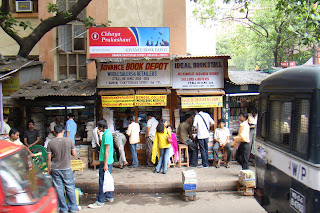
Our story had its beginning in a conversation a week before our visit. An uncle of mine had dismissed the College Street boi para (roughly, “neighbourhood of books”) as a flea-market for crammers’ texts and second-hand potboilers. “Can you find anything in any language that is RARE, let alone interesting?” Out of nowhere, we fixed on Jadunath Sarkar, doyen of Bengal’s historians, as the touchstone. Could we find anything by him on College Street? So it came to pass that 11 o’clock on a cloudy humid Saturday saw us stepping gingerly through puddles, wiping our faces repeatedly under the combined onslaught of humidity and a faint drizzle, glancing with unconcealed disgust at stall after stall that advertised “CBSE-ICSE-ISC text” or “Medical – JEE – CAT”. Was THIS what College Street had been reduced to? Where were the bonanzas that our parents’ generation gloated over, the pamphlet autographed by Toru Dutt or the 1898 edition of the Materia Medica?

The Coffee House lane (Bankim Chatterjee Street) is entirely devoted to textbooks. (What a waste - even during our student days some decades ago, textbooks never figured on our list of priorities.) Yet it makes historical sense. Hindu College in 1817, Sanskrit College, the Calcutta Medical College in 1835, Calcutta University and later Presidency College – these were all started on College Street or just off it in the Potoldanga area. Small wonder that the College Street boi para took root, almost 200 years ago, from the textbook trade. For more esoteric books and for the latest rage, the gentry ordered in from the booksellers in the Chowringhee area. It was only at the turn of the (previous) century that College Street’s booksellers increased the ambit of their trade. And the stories of lost treasures glimpsed in dusty piles on the pavement took root, grew, gave rise to myths and tall tales.

These tales were most often told in the Coffee House, the adopted home of generations of self-proclaimed Bengali intelligentsia. Housed in the Albert Hall (yes, of course there had to be one in the “second city of the Raj”! This one was built in 1876), this was the place to enjoy the best adda, the slowest service and the most tolerant waiters in the world. Poets, economists, politicians, charlatans, they all spent hours and days over carefully nursed cups of coffee and shared cigarettes under the slow revolving fans strung on beams between the upper floor balconies. Every Bengali of note, from Rabindranath Tagore to Amartya Sen, has been a patron. One of the most enduringly popular Bangla songs is Manna Dey’s anthem to nostalgia, Coffee House-er shei adda. Yet like most things Bengalis hold dear, it has been on the brink of oblivion for years. It took a petition from the faculty of Calcutta University and the Presidency College to keep it from being shut down in 1958. Eventually, in 1995, Mudar Patherya led an initiative for essential renovation and again in 2007, Bengal Shelter cleaned and renovated it. Today it is almost chic in its ambience. Of course there are old-timers who miss the smoke-blackened walls and the chipped Coffee Board saucers. But they still serve the most soul-satisfying greasy “mutton Afghani”. I can vouch for this because, of course, we ended our College Street expedition there.

But again the time-line jinks. The book search, yes. We pushed through the crowds on the sidewalk in our search for old books, yet all we found within that tunnel of blue polythene rain-sheets was text-books. And children’s books. And self-help books. We crossed to the other side of the road and found a different world. Piles upon piles of pulp fiction, literary criticism, photography, yearbooks. Obviously this side, along the wall of Presidency College, is more fun. Subol Moitra from Medinipur peeped shyly from his book-walled alcove and edified us about the complicated system of rental and sub-rental that governed the economy of these six by four “locations”. But where oh where, among this rubble of Harold Robbins and Fashion Photography, were we to find anything by the great Jadunath Sarkar? Back to the other side we went, picking our way between reddish-chocolate mini-buses, bright yellow taxis and rickshaws with schoolchildren peeking out from behind the inevitable blue polythene sheet.

From an article by Amit Roy I found that six bookshops opened between 54 College Street and 70 College Street in the 1870s. One of these was Gurudas Chatterjee’s Bengal Medical Library, which is now the venerable institution of Chatterjee & Sons, right opposite the gate of Presidency College. But alas, the harried gentleman behind the counter was positive that they had nothing by Jadunath Sarkar. He could try and get it for us if we left an order, but that was not within the rules of the game. On we went, past an open shop-front that revealed no counter within, just piles of books in the semi-dark, like the Xiqian terracotta army waiting to be brought back to life. Craning my neck to check the shop-signs farther down, I saw “Dasgupta & Co. (P) Ltd.” Why had I not thought of this earlier? For many years Arabinda Dasgupta has been my go-to man when I want a book that’s not available over the counter, but we had never met in person, we had always been voices on the phone. We ventured in and asked for him. Within minutes we were sipping coffee at a small table in a room that seemed to be built with books. If one looked closely one could see an occasional patch of wall or a piece of furniture, but the foreground, background and middle ground consisted entirely of books and nothing else. The bonus lay in overhearing the impassioned conversations on the telephone. “Drugs and Cosmetics, have you sent that to Bombay yet? You should have it by Tuesday morning, call me if it hasn’t reached you.” “Where did you put that Swift on Grammar? Somebody from Raj Bhavan will be here in an hour to collect it.” “Hanif on Accountancy? Yes, we have a couple of copies, but it’ll take some time to get it to you in London.” The total experience, the combination of focussed business and casual erudition, was somewhere between a library and a stock exchange.

Coffee done with, we got down to the serious business of Finding Sir Jadunath. “But of course, I’m sure I saw something by him.” And Mr. Dasgupta shot off to hunt among the shelves, returning for a moment to hand me, as a sort of appetizer or amuse bouche, a collection of essays by F. Max Mueller (I point to India). Within minutes he returned triumphant, bearing a book in a slightly battered yellow cover – Introducing India, edited by K.N. Bagchi and W.G. Griffiths (yes, THAT Griffiths), first published in 1947 and reprinted in 1990 by Dr. Ashin DasGupta, Administrator, Asiatic Society, 1 Park Street, Calcutta. Seeing our brows furrowed, he opened it and pointed to an article on Indian history by, yes yes YES, Jadunath Sarkar! Our quest was over!

But not our expedition. We were led on a tour of the three floors of the shop. Up a spiral staircase of wrought-iron, through old doors under raftered ceilings, and in every room, books and more books. If there is a heaven on earth, it is this, it is this, it is this! Books the way they can be savoured best, with Arnold Schwarzenegger’s Encyclopaedia of Body Building lying atop a history of football on the Calcutta maidan and next to an anthology of travelogues from Central Asia, with In search of an equation sharing floor space with an illustrated history of Central Indian tribes. A balcony shaded by a gnarled old neem tree, with a view of College Street on one side, and on the other a wire-mesh window behind which a dignified old gent tapped away at a word-processor but with a trusty typewriter beside him as a back-up. It took an effort of will to leave, but deadlines beckoned. We took our leave and hied ourselves to the Coffee House to celebrate, where Javed Khan, in cummerbund and turban, posed for us after he brought us (as expected) the best mutton afghani and the worst cold coffee possible.

College Street had not done with us yet. As we descended the uneven stairs, we noticed a series of posters on the wall – “Mohamichhil (Great Procession) on –th July”. But that’s today! We’ll be stuck here for hours! Our well-fed saunter changed to a sprint. Sure enough, traffic was halted outside, a posse of policemen in white uniforms were massed along the tram-tracks and the head of a procession complete with banners was visible 50 metres to the south, opposite the University gate. Fortunately our car was parked farther north, our ungainly canter was just fast enough to get to it before the procession started moving and we were able to speed away before the road was closed off. This was one time we didn’t stop to find out “what happened next”. But true to form, College Street had started another story before we had quite finished the one before.


(Stodgy, yes, but I am reliably informed that some version of this has appeared in an on-flight magazine)

Monday, June 01, 2009

Snippet

I think I was about 6 years old. They’d come down the road a little before 7 in the morning, when I was just about awake, and from the bedroom where I lurked under the covers for those oh-so-sweet ten extra minutes of sleep on a schoolday morning I’d hear them coming. They always sang the same song – Bhojo Gourango, koho Gourango, loho Gourango’r naam re”. “Sing of Gouranga, speak of Gouranga, take Gouranga’s name.” The tune that has been used by Chandrabindoo for the satire “Aaji ei Boshonto diney”.

An old man and a boy. The man seemed infinitely old to my 6-year-old eyes; when I review my memory, I realise he must have been about 50. The boy would have been a year or two older than me, or perhaps short rations made him look younger. But his clothes were always clean, unlike the draggled rags of his bearded companion. His voice was very sweet, soaring above the man’s tenor in a tracery of song. I’d run out to the balcony, lean over the railing to hear them. They always walked from the Raja Basanta Roy road crossing towards Lake Market, perhaps to sing for a cup of tea and biscuit before the tea stalls on Janak Road. The first few times, they’d look up at me, the boy would put out his hand with the palm upwards without interrupting his song. I went and asked my mother for a coin. She gave me 25P, a denomination that I don’t see these days and yet a fair amount for alms back then. The boy caught it deftly as I tossed it from the balcony, raised the hand to his forehead in salute and walked on, still singing.

It became a habit. Twice or thrice a week I’d hear their voices raised in song and run out to the balcony with a 25P coin, then watch them wander off towards the market. In the year or so before we moved to Delhi, I never spoke to them, never asked them any questions. They never broke off their song to speak to me. But it lingers in my memory like a grainy shot from an old film. Complete with slightly scratchy soundtrack.

Sunday, May 13, 2007

River's flow

In the haze of the river-morning, I thought a flotilla of small craft was proceeding downriver. Now, as the sun climbs, I see clumps of leaves, vegetation washed out by the tides, slowly floating past the sand-banks into the inner channel that hugs the hedge. As morning drifts to afternoon, the light brightens, hardens, the shadows are sharper and the leaves more still.

Morning and evening, the light dances on the broad leaves of the mallenda as the breeze stirs the waxy white blossoms. The mango trees whisper around their burden of unripe fruit. Shadows soften equally the garden and the distance across the river. Tiled roofs, brick kilns, haystacks and a temple sit astride their broken reflections along the far shore. One man in a pink vest and a conical straw hat poles his bobbing coracle towards mid-stream. As evening draws in, the other bank fades to a smudge in the half-light.

Only the country boats that chug past are clear. Lives float past as I sit by the window, lives defined by their clothes – colourful saris, the ‘bush-shirts’ and nondescript trousers of office-goers (perhaps some are returning from the long flat house downriver, built by the Dutch nearly 200 years ago, where I went to work for some years), the faded photuas­ and ­dhotis of the men who work with their hands. Bicycles, nets, shopping bags. And the beat of the thumping engines floats up to us some seconds after the boats come into view, like somebody beating clothes very fast at a distant ghaat.

Jackfruit trees seem to generate their own shadow. The bloated fruits hang in the bends of the trunks, the leaves especially dark green, an air of faux mystery shrouding these pretenders that are sometimes vegetable, sometimes fruit. Not fair. Only the mango trees should have that dual identity, sometimes dark and sometimes a glistening green, the fruits invisible in the dark of evening but light and bobbing in the light of day, clustering with a promise of plenty that makes the teeth ache as one remembers summer holidays and chutneys from childhood.

Memories. Of course that’s what this morning is all about. From the brilliant colours of a child’s paint-box –jacarandas a startling violet, yellow and red on the other trees – that recall long summer afternoons roaming round Salt Lake in the ’70s, to the orderly flower-beds and hedges that remind me of the years I worked in this district and visited this place ever so often, and the hum of the AC and the faint brown-paper smell of the carpet that bring back every ‘guest-house’ I have stayed in over the last 30 years.

Memories. Lines of coconut palms, their fronds glistening in the afternoon sun, the occasional crow floating into one with its wings spread and feet outstretched like landing gear. Bringing back memories of aching lonely afternoons as a probationer in Chinsurah, sitting in a little clapboard cubicle with a lazy fan, nibbling at a cold ‘vegetable chop’ and waiting for 3 o’clock when the little swimming pool outside would fill with children and their clamour.

The ­luchi at breakfast and the aromas of lunch on the boil downstairs, gobindobhog rice and mutton curry, bringing back a thousand Sundays in a hundred different places. Family sprawled on sofas and beds, desultory conversations, the television alternating between Tom & Jerry and the news channels depending on who usurps the remote. Retreating to the other room for a pipe, the rich chocolatey tobacco smell evoking my study and my rocking chair in my home 40 miles away.


Back to the present. I’ve made a start on my resolution to write a little something every day, I need a shower and my beer is going flat. More tomorrow. One hopes.

**** ****

Sunday, March 11, 2007

Perfick. Quite perfick.

A morning stroll past the paddock, down the tree-lined avenue with dead leaves and dewy grass underfoot. Three polash trees in bloom, posing in a row at the edge of the 16th green, like dark Santhal girls in their red-bordered ­saris and red bangles. Afterwards, a time-warp - buttered toast and marmalade in the 19th Hole. And The Statesman. I’d no idea people still read that paper! But somehow it fits in with the shaded peace and the tang of the marmalade. And the breeze from the fans, that first day of spring when it’s just a little chilly with the fan on but just a little too stuffy to leave it off. The kind of morning when I feel about 12 years old again and a Sunday is a vast expanse of Possibilities.

If only they still had morning shows at Metro or New Empire and I could go watch Mel Fahrer and Stewart Granger in Scaramouche.

A series of very minor Nice Things. Like Lay Down, Sally coming to life as I start the car. Or putting it in neutral at the top of the Gariahat flyover and coasting all the way to the traffic lights at Ballygunge Phnari. The perfect cup of coffee with the morning papers, sitting on the balcony and feeling the day stir to life with bird-song and the scent of green things.

Caught up with T* for breakfast. Udipi Home on Jatin Das Road. A small glow sign outside thanks APJ Abdul Kalam and Viren Shah for the opportunity to serve them breakfast AND lunch at Raj Bhavan on 21st January 2003. A blackboard proclaims the prices and announces the availability of pickles and savouries. And beds for a hundred rupees a night. Inside, a verandah has been converted into a dining room. The place oozes atmosphere. Stupid me – I’ve passed this place a few thousand times but never ventured in before. The food is outstanding. – dosai with amazing chutneys, onion vadas, followed by strong sweet ‘dancing coffee’. The TF or Tripti (Contentment) Factor is very high, tending towards 1. Bliss.

The whole morning is very Pop Larkin. Perfick. What have I done to deserve this?

It strikes me when I log on. This Simple Desultory Philippic is two years old today. How appropriate. Food. Calcutta. A little nostalgia. Leisure. A few moments of peace, even. Which (alas!) is all that this space seems to be good for. No issues of great import, not enough energy for strong opinions. A sort of Emsworthian potter down the Yew Avenue of life, with the occasional pause to contemplate the floppiness (or otherwise) of hollyhocks, or a detour to give the Empress a comradely scratch along the spine. Faff of the first water, all of it.

And yet, and yet … Thanks to my meanderings here, I’ve got to know Interesting People. I rate ‘Interesting’ far above ‘Nice’, but as a bonus, they’ve been Nice too. Well, mostly. (Stern look at certain Obstreperous Children with No Respect for the Elderly – you know who you are!) I’ve spent huge amounts of time reading their (your?) blogs and following their lives and opinions, but it’s all been worth it. The satisfaction of some give and take in the comments section, the unique pleasure of meeting a fellow blogger for the first time in some unexpected corner of the world. Sadly, no revenue from ads (even though readership is well into double figures by now, thank you very much), not even a nomination for an Indibloggie (cue discreet wiping of single tear) but, after nearly two years, offers to Pander to the Public for Pelf. (I love pelf!).

So, all in all, it’s been rather nice. Very nice, in fact. Oh what the hell - as of now, it’s perfick. Quite perfick. Before I get entirely maudlin - thanks, all of you.


**** ****