Sadly enough, the poet had left the building and a hustler had taken up position. Hence ads for lubricants, paints, calcium tabs. Bloody awful "in-film" stuff.
But the one-man band more than made up for everything.
****
Two decades ago, Tinnu Anand crafted the Man's come-back vehicle, Shahenshah, making full use of the biggest resource at his disposal. To wit, the Man himself. Low-angle shots, lighting, taali bajao lines (Rishtey mein toh tumhaare baap lagte hain .. .. I loved that!), the works.
Here, in Viruddh, the Man has no resonant lines. He is not a super-hero. He shuffles where once he strode. (Mallika Sherawat would be SO disappointed. And has anybody else noticed how Amitabh's walk in Trishul, Deewaar, Don, even Silsila, is copied from that bank-robbery sequence in Dirty Harry?)
****
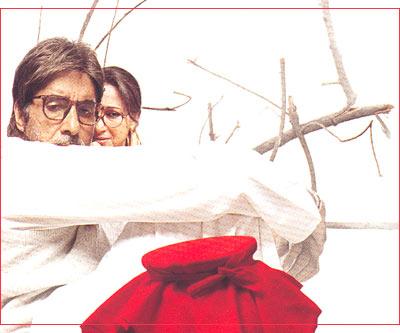
Viruddh is a bad film. Somewhere in the muddle there was the skeleton of a good story. Mahesh Manjrekar just lacked the calibre to put flesh on the bones. Where the film could still have survived if sketched on a lower and more serious key, he pulls it down by trotting out some of the usual suspects.
National integration (or at least Mumbai integration), with a fine actor like Shivaji Satam wasted behind hideous false teeth and a dikra accent (Prem Chopra plays the obligatory Sardarji). The indulgent mother, with Sharmila’s sensible, self-reliant character suddenly hamming it up when her son calls from London. The villainous politician (why is it that Bollywood recognises only Chief Ministers and Home Ministers? Can anybody recall a Hindi film minister with some other portfolio?). The obligatory minority rep with the heart of gold (Sanjay Dutt looking particularly wooden in yet another re-hash of the persona he found with Vaastav). The firang girl who is won over by the Indian wooer’s “foynn krrakter".
The film is further marred by some truly awful in-film advertising. The script-writer must have run out of ideas, or these sequences may be the director’s protest against the producer’s money-grubbing. Either way, they are truly cringe-worthy and widen the holes in the film’s credibility. (To accommodate Western Union, the film has John A’s student character sending 15 grand a month to his old man in Mumbai. Some scholarship that must have been.)
This is all much of a muchness with the generally shoddy character development and the holes in the plot. Except for Sharmila as the wife (bar the aberration mentioned), none of the characters holds together as a credible person. Even the sea-change that Bachchan’s protagonist undergoes is hardly in keeping with his slightly weak character in the first half of the film.
It could have been a gripping exposition of the David-versus-Goliath theme, but like all too many Bollywood men in a hurry, Manjrekar wraps up the story with a simplistic and absolutely incredible denouement.
****
One must, however, give the man credit where his tactics have paid off. The banter between the ageing couple is well-written (and Sharmila almost measures up to Amitabh in this part). Sachin Khedekar is made to mouth some awfully pretentious lines in the opening sequence but finds his length later on and uses his silences with great assurance. The new girl, Anousha Dandekar, has to speak Hindi as if it is a foreign language and does a good job. Even John Abraham is credible.
Give the man credit for realising the potential of silence when Bachchan’s eyes fill the screen. For the spare sound design where a subdued whisper in that gravelly baritone walks up your spine.
Give him credit, above all, for being a shrewd product manager.
For two and a half hours, there's hardly a frame without the Man in it. And how he delivers. In a film with shoddily finished sets, poor continuity, botched make-up and unimaginative camera; with a supporting ensemble whom the script-writer and the director forget somewhere along the line; in a strange two-in-one product that changes mood and colour mid-way, the Man moves from sit-com to film noire with silken ease. The ease not just of a master but of a master craftsman who has never stopped learning his craft.
For two and a half hours, we watch Amitabh Bachchan plying his trade before the cameras. And for two and a half hours, he holds us in thrall.
**** **** ****